Employer obligations are numerous, and taxes are arguably a very powerful. It is advisable to know which taxes to calculate and withhold from staff, how a lot to contribute as an employer, when to file, and extra. And, you might want to know what employment tax returns you might want to file.
7 Employment tax returns to know
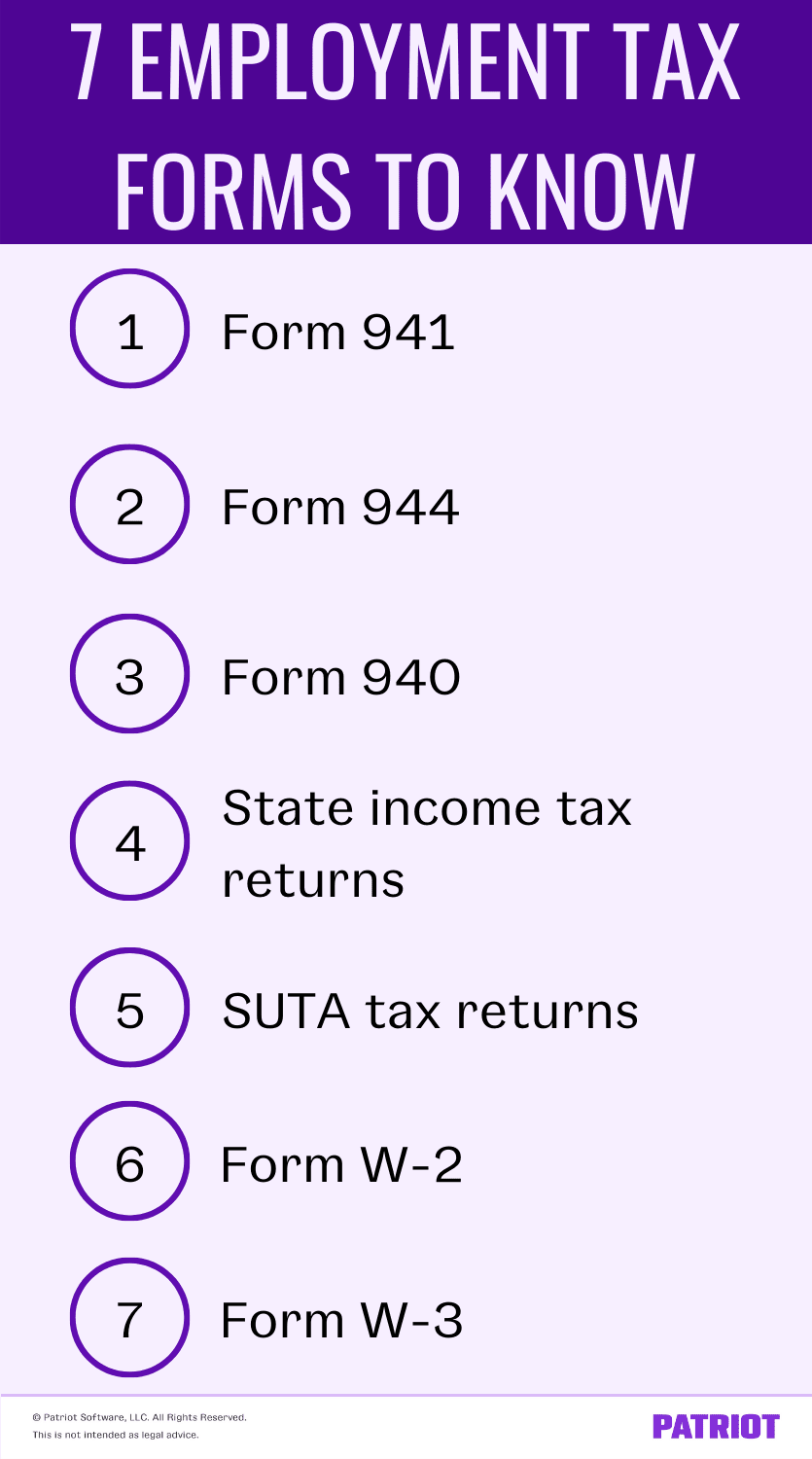
There are seven fundamental employer tax returns it’s best to know. These tax returns report your and your staff’ tax liabilities to the federal government. These tax returns embrace:
- Type 941
- Type 944
- Type 940
- State earnings tax returns
- SUTA (state unemployment) returns
- Type W-2
- Type W-3
Every tax submitting additionally has its personal employer tax return deadline (and we’ll get to these).
1. Type 941
IRS Type 941, Employer’s Quarterly Federal Tax Return, is an employment tax return employers use to report worker wages and federal payroll taxes. Type 941 is the quarterly tax return employers use to report payroll taxes and wages.
Most employers, however not all, use Type 941 for his or her payroll tax and wage reporting. Info on Type 941 consists of:
- Worker wages
- Federal earnings taxes withheld
- Social Safety taxes (worker and employer contributions)
- Medicare taxes (worker and employer contributions)
- Reported suggestions, if relevant
- Extra taxes withheld, if relevant
- Sick pay, if relevant
- Group-term life insurance coverage, if relevant
Type 941 additionally features a particular line asking what number of staff have been paid for the twelfth day of a particular month every quarter (March 12, June 12, September 12, and December 12). Solely embrace the variety of staff who acquired wages, suggestions, or different compensation for the pay interval that features the twelfth of the relevant month.
After you deliver on staff and file your very first Type 941, you have to proceed to file the shape each quarter. Choose employers are exempt from submitting Type 941, together with:
- Those that have filed a last return
- Seasonal employers
- Family employers
- Farm employers
- Those that obtain notification from the IRS to file Type 944
Kinds 941 are due by the final day of the month following the tip of the quarter. For instance, the primary quarter ends March 31, so Type 941 is due April 30. If the final day of the month following the tip of 1 / 4 falls on a weekend or banking vacation, submit the shape by the following enterprise day.
Type 941 is due quarterly, however that doesn’t imply there are employer quarterly tax funds. As an alternative, the IRS informs you when it’s best to deposit the tax funds (e.g., month-to-month). Test with the IRS for extra info.
2. Type 944
The annual model of Type 941 is Type 944, Employer’s Annual Federal Tax Return. Type 944 studies the entire identical info because the quarterly Type 941. So, you have to embrace taxes paid by employer on behalf of staff and the employer contributions on Type 944.
Not like Type 941, don’t record the variety of staff paid on the twelfth day of a particular month. And, solely file Type 944 if the IRS instructs you to take action.
Employers should meet sure standards for the IRS to tell them of their Type 944 submitting standing. Solely small companies with $1,000 or much less in annual payroll tax liabilities can file Type 944.
New employers might request to file Type 944 when making use of for an Employer Identification Quantity (EIN). A line on the applying kind permits employers to point anticipated payroll tax liabilities of $1,000 or much less.
File Type 944 by January 31 annually. If January 31 falls on a weekend or banking vacation, file the shape by the following enterprise day. Enterprise house owners who filed a last return mustn’t submit Type 944.
3. Type 940
Most employers should pay federal unemployment tax (aka FUTA tax). Employers pay 6% on the primary $7,000 in wages per worker for FUTA tax. Nonetheless, most employers can obtain a FUTA tax credit score of 5.4% and solely pay 0.6% (6% – 5.4%).
With out the tax credit score, employers pay as much as $420 for FUTA tax (6% X $7,000) per worker. With the tax credit score, employers pay as much as $42 per worker (0.6% X $7,000).
Workers don’t pay FUTA tax. Due to this fact, don’t deduct FUTA tax from worker wages. Nonetheless, use the worker’s wages to find out how a lot cash you owe for the tax.
Employers should file Type 940 in the event that they:
- Paid wages of at the very least $1,500 to any worker throughout the usual calendar yr
- Had an worker (full-time, part-time, or short-term) work anytime throughout 20 or extra weeks (the weeks do not need to be consecutive)
If an employer sometimes has staff however didn’t pay staff throughout a particular calendar yr, the employer should nonetheless file Type 940. Use the shape to state that you simply didn’t make worker funds.
On the finish of the tax yr, use Type 940, Employer’s Annual Federal Unemployment (FUTA) Tax Return, to report your annual FUTA tax legal responsibility. File the employer tax return kind by January 31 of the next tax yr.
4. State earnings tax returns
Most states require staff to pay state earnings tax (SIT). If the state requires staff to pay earnings tax, the employer should withhold, deposit, and file the taxes with the state.
Particular person state tax kinds differ. And, employers should file state earnings tax kinds with every state during which they’ve staff until the worker lives in a state with out an earnings tax.
9 states don’t have SIT:
- Alaska
- Florida
- Nevada
- New Hampshire
- South Dakota
- Tennessee
- Texas
- Washington
- Wyoming
Some states have tax reciprocity agreements. In case your state has a reciprocity settlement with one other state the place you’ve staff, your worker might request an exemption. If the worker receives an exemption, withhold earnings taxes for the state the place the worker lives, not for the state the place the worker works.
Deadlines to file differ by state. Usually, employers should file state earnings tax returns by the tip of the month following the tip of the quarter. Test along with your state for extra info.
5. SUTA tax returns
State unemployment tax returns differ by state. And, some states have completely different names for the tax, together with state unemployment insurance coverage, SUI, and reemployment tax. Usually, SUTA is an employer-only tax. Nonetheless, staff in Alaska, New Jersey, and Pennsylvania should additionally pay SUI tax.
Most employers should remit and file SUTA taxes. Nonetheless, some companies could also be exempt from paying SUTA (e.g., nonprofits). The state notifies employers of their present SUTA tax charge and the wage base per worker. Usually, new companies use the brand new employer SUTA tax charge for the state.
Tax submitting deadlines might differ. Usually, SUTA tax returns are due by the tip of the month following the tip of the quarter. Test along with your state’s unemployment division for extra info.
6. Type W-2
Each employer should distribute Type W-2, Wage and Tax Assertion, to each worker who labored for the enterprise in the course of the yr. If an worker not works for what you are promoting, you have to nonetheless ship Type W-2 to the previous worker. Type W-2 is the tax return for employed people.
Type W-2 studies details about staff’ annual wages, together with the gross wages and taxes withheld. As well as, the shape might embrace different info, reminiscent of tip earnings or well being financial savings account contributions.
The shape additionally lists:
- Worker’s Social Safety quantity
- Worker’s private info (e.g., title and tackle)
- Enterprise’s title, tackle, zip code, and EIN
You may additionally want to finish extra fields on the shape, reminiscent of allotted suggestions or nonqualified plans.
Type W-2 is because of staff no later than January 31. And, you have to submit Type W-2 to the Social Safety Administration (SSA) by January 31 annually.
7. Type W-3
Along with Type W-2, employers should full and submit Type W-3, Transmittal of Wage and Tax Statements. Type W-3 summarizes the Kinds W-2. IRS Type W-3 compiles all worker info from all Kinds W-2. It’s not a standalone kind, and employers should file it with copies of all Kinds W-2.
Type W-3 reveals the IRS the overall quantity you paid to all staff, in addition to the overall federal earnings, Social Safety, and Medicare taxes withheld from all staff. The shape additionally informs the IRS in regards to the variety of staff a enterprise has and the overall variety of Kinds W-2 you’re submitting it with.
The IRS compares Kinds W-2 and W-3 to the data on Kinds 941 or 944 for the tax yr.
Submit Type W-3 to the SSA by January 31. If January 31 falls on a weekend or banking vacation, submit by the following enterprise day.
This isn’t supposed as authorized recommendation; for extra info, please click on right here.
The post Employment Tax Returns | Kinds, Due Dates, & Extra appeared first on TheBestEntrepreneurship.
source https://thebestentrepreneurship.com/employment-tax-returns-kinds-due-dates-extra/

No comments:
Post a Comment